

Maintenance and Spousal Support in Kentucky:
What to Know During Divorce
Spousal support is a subject that comes up in many divorces. In high profile cases, the subject can generate flashy headlines like: “Dr. Dre Ordered to Pay Nicole Young $3.5 Million a Year in Spousal Support amid Divorce”1 or “Offset Reportedly Asking Spousal Support From Cardi B.”2 However, the discussion of spousal support in these cases often is void of any details about what spousal support is and when a court may award it in a divorce. Newsworthy headlines on the subject can lead to many misconceptions including the belief that spousal support is only paid by men, or that it is always a permanent obligation, or even that every divorce will result in one spouse paying support to the other. The truth is that spousal support is a nuanced matter. Each state may vary in its laws around spousal support. This article will examine spousal support under Kentucky law.
Spousal support is a financial payment that one spouse may be ordered to pay to the other by a court if it determines that financial assistance is necessary.
You may have heard this form of support referred to as “alimony.” However, “maintenance” is the term used in Kentucky statutes. In any divorce action there is a possibility that a court may order one party to pay “maintenance” to the other during the divorce case, and/or after the parties are divorced. When a court considers maintenance as part of a divorce, first it must determine whether maintenance payments from one spouse to the other is necessary. If it is determined to be necessary, the next step is determining the amount and duration of the payments.
When Will a Court Order Maintenance to be paid?
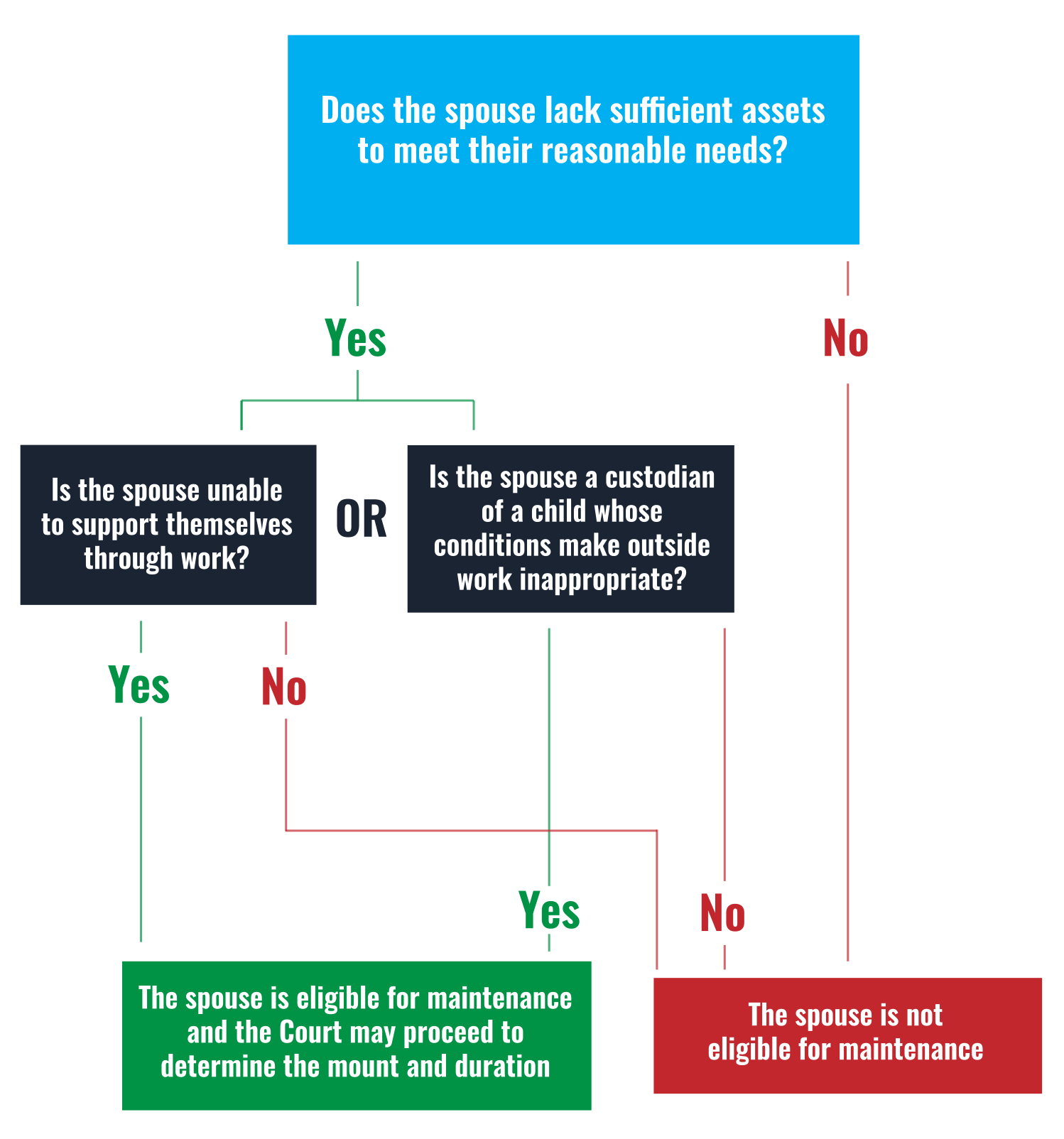
In Kentucky divorces where a party requests maintenance, first the court must determine whether a party is entitled to receive financial support from the other party at all. There are a few questions the court has to answer according to the statute when deciding whether maintenance is appropriate:
1. Does the party seeking maintenance lack sufficient property to meet his or her reasonable needs?
2. Has the party seeking maintenance demonstrated that they are not able to support himself/herself through appropriate employment OR have they demonstrated that they are the custodian of a child who makes employment outside the home inappropriate?
If the party seeking maintenance is caring for a child under circumstances that make outside employment inappropriate, then Courts will not necessarily need to consider whether they can support themselves through employment. This circumstance may arise in situations where a spouse is caring for a very young child (or children) or a child with disabilities. In those instances, the court may determine it is not necessary for the spouse seeking maintenance to support themselves through outside employment.
Based on the evidence presented by the parties, if the answers to Questions 1 and 2 are “yes,” the court will go on to consider what the appropriate amount of maintenance should be.
Is a Spouse entitled to Maintenance?
How the court determines the maintenance amounnt
If the Court does answer “yes” to the questions above, the next step will be for the court to consider the amount and duration of maintenance that is appropriate. Unlike child support, which has guidelines for the Court to use in determining the amount that must be paid, maintenance is more subjective. The court’s determination depends on several specific factors that are considered for each case:
(a) The financial resources of the party seeking maintenance, including marital property apportioned to him, and his ability to meet his needs independently, including the extent to which a provision for support of a child living with the party includes a sum for that party as custodian
(b) The time necessary to acquire sufficient education or training to enable the party seeking maintenance to find appropriate employment;
(c) The standard of living established during the marriage;
(d) The duration of the marriage;
(e) The age, and the physical and emotional condition of the spouse seeking maintenance; and
(f) The ability of the spouse from whom maintenance is sought to meet his needs while meeting those of the spouse seeking maintenance.
How these factors affect the amount and duration of a maintenance award will depend greatly on the specific circumstances of each case. Although there are resources that can offer estimates as to what amount of maintenance may be appropriate in a case, there are no fixed rules or formulas under Kentucky law.
In some cases, it can be relatively easy to see where a court weighing these factors may determine that a substantial sum of maintenance paid for a long-term or permanent basis may be appropriate. A long-term marriage, where one spouse was the primary or sole income earner during the marriage, may make a strong case for a significant award of maintenance for a long period of time or permanently. However, a short marriage where the parties have similar incomes may make a weaker case for significant maintenance to be ordered.
For example, imagine a divorce action where John and Jane were married for 40 years. John never worked outside the home during the marriage, and Jane made $1,000,000 a year for most of the marriage. In this scenario, the considerable length of the marriage along with the likelihood that John would have fewer financial resources to provide himself the same standard of living that was enjoyed during the marriage would support an award of maintenance. Additionally, because John hasn’t worked in 40 years, any income he would earn after the marriage would likely be far less than Jane’s. Given these factors, there would be a strong basis to award John a substantial amount of maintenance to be paid for a long period of time, or even permanently.
However, even in this example, there may be circumstances that would limit the maintenance that Jane would have to pay to John. For instance, if in the same divorce John was awarded assets such as a large retirement account or income producing real estate (e.g., a rental property), then John may have nearly equal financial resources as Jane. In that case, John’s access to those financial resources may reduce the amount of maintenance that a court may find necessary for Jane to pay John.
In many cases, the determination of how much maintenance is appropriate may be even more convoluted than the example above. For example, consider a divorce in which Jack and Jill were only married for 15 years, Jill earns $1,000,000 per year, and Jack stayed at home during the marriage but could return to work after the divorce and earn $200,000 per year. Here, the court’s evaluation of the factors would likely result in Jack receiving much less maintenance from Jill as compared to the amount John might receive from Jane in the prior example. This is because Jack and Jill’s marriage was significantly shorter, and Jack is capable of earning significant income.
It is important to remember that the examples provided above will not always align with the court’s maintenance determination; the result will always depend on the specific facts for each case. Collectively, the court will consider all of the factors and how they apply to each case to determine the amount and duration of a maintenance award. While the specific evidence will change depending on the case, there are several items that are routinely considered by courts. Courts will consider the assets and income available to each spouse after the divorce. If one spouse is not employed, the court may also consider whether that spouse can obtain gainful employment and, if so, what they may expect to their income to be. Courts will also consider the parties’ living expenses and the standard of living that the parties enjoyed during the marriage, along with each parties’ expected living expenses after the marriage. While shorter marriages tend to make a weaker case for maintenance, there are no requirements for a marriage to be any particular length before the Court considers maintenance.
If you are considering a divorce and believe that you may be entitled to maintenance or if you want to know whether you may be ordered to pay maintenance, it is important to consult with an experienced attorney to discuss how these factors may apply to the specific facts of your case.
Child support and maintenance
In a case that involves both maintenance and child support, the Court’s maintenance award may affect
the amount of child support owed by one parent to the other. Generally, when determining child support, maintenance will count as income to the parent receiving it and lower the combined income used to calculate child support, which could result in a lower child support obligation. KRS 403.212 establishes
the Kentucky Child Support Guidelines. Under the statute, when determining a parties’ income for the purpose of calculating child support, the term “gross income” is defined to include “alimony or maintenance received.” Additionally, when establishing the parties’ combined gross monthly income, courts will deduct the amount that a spouse currently pays in maintenance to any current or prior spouses.
Modification
Maintenance awards can be modified in certain circumstances , the party who has been ordered to pay maintenance may seek to have it lowered or the party receiving maintenance may seek to have it increased. A maintenance award ordered by the court may be modified upon a showing of changed circumstances so substantial and continuing as to make the terms unconscionable. This is a high standard to prove, as under Kentucky law, unconscionable means “manifestly unfair or inequitable.”
Additionally, unless the parties have agreed otherwise, Kentucky law provides that maintenance obligations are terminated at the death of either party or if the party receiving maintenance is remarried.
Maintenance and taxes
Under the Tax Cuts and Jobs Act of 2018, tax treatment of maintenance for federal income tax purposes has changed. For orders of maintenance occurring after 2018, maintenance payments by the payor are no longer tax deductible. Moreover, the maintenance paid to the receiving spouse is not taxable income.8 These rule changes do not apply to agreements and orders for maintenance that were entered before 2019. It is important to note that the IRS has several specific regulations and rules as to what is considered maintenance for tax purposes, and how certain payments may be taxed. Additionally, how maintenance may affect your state tax obligations will vary from state to state. If you believe you might pay or receive maintenance, you should consult with a tax expert to determine how that may affect your tax obligations.
Bottom Line: Talk to an Attorney
Maintenance or spousal support in any Kentucky divorce is very specific to the needs of a particular case. While there are often headlines in the news about spousal support when it comes to famous cases, those reports do not provide much information helpful to you and your case. If you are considering a divorce and want to know if and how maintenance may play a part in your case, it is important to discuss your case with experienced attorney licensed in your state.
At Brown Carrington, PLLC, we care. Contact us today to schedule a consultation with one of our experienced Kentucky family law attorneys to discuss the details of your case and determine your best path forward.
Written by: Joe Denger
Based in Kentucky, Joe Denger is a family law attorney at Brown Carrington focusing on divorce, custody, and child support cases. His background in psychology gives him a unique perspective on the emotional challenges families face, while his experience in the courtroom ensures strong, strategic representation. Joe takes pride in providing clear communication and steady support, guiding his clients through life’s most difficult moments with empathy and confidence.
Learn more about Joe here.

Edited by: Catherine Pierce
Request A Consultation
Submitting your information does not create an attorney-client relationship.
DISCLAIMER
THE INFORMATION PROVIDED IN THIS POST IS FOR GENERAL INFORMATIONAL PURPOSES ONLY AND DOES NOT CONSTITUTE LEGAL ADVICE. LAWS AND REGULATIONS VARY BY STATE, COUNTY, AND SPECIFIC CIRCUMSTANCES OF YOUR MATTER, AND THE INFORMATION PRESENTED HERE MAY NOT APPLY TO YOUR PARTICULAR SITUATION. ALWAYS CONSULT WITH A QUALIFIED FAMILY LAW ATTORNEY TO OBTAIN ADVICE TAILORED TO YOUR INDIVIDUAL CIRCUMSTANCES. REVIEWING THIS BLOG POST DOES NOT CREATE AN ATTORNEY-CLIENT RELATIONSHIP BETWEEN YOU AND THE AUTHOR, PUBLISHER, BARROW BROWN CARRINGTON, PLLC OR ITS ATTORNEYS. THE AUTHOR AND PUBLISHER ARE NOT RESPONSIBLE FOR ANY ACTIONS TAKEN BASED ON THE INFORMATION PROVIDED IN THIS BLOG POST.
IF YOU HAVE LEGAL QUESTIONS PLEASE CONTACT OUR OFFICES DIRECTLY FOR A CONSULTATION IN COLORADO, FLORIDA, INDIANA, KENTUCKY, OR OHIO.