

Navigating High-Conflict Co-Parenting:
A Guide to Parenting Coordinators in Indiana
Co-parenting is rarely easy, but when disagreements become constant, the legal and emotional toll can be exhausting. In Indiana, the court offers a specialized tool to help families move past the deadlock: The Parenting Coordinator (PC).
If you feel like you’re constantly back in court over minor schedule tweaks or communication breakdowns, here is everything you need to know about how a PC works and how to use the process strategically.
What Exactly is a Parenting Coordinator?
Think of a Parenting Coordinator as a “referee” for your parenting plan. Under Section V of the Indiana Parenting Time Guidelines (IPTG), a PC is a neutral professional appointed to help high-conflict parents implement court orders and resolve disputes in real-time.
The Golden Rule: A PC does not replace the Judge. While they can help resolve day-to-day friction, the court retains the final say on major issues like legal custody, child support, and permanent changes to parenting time.
What a PC Can (and Cannot) Do
A PC’s primary job is to protect the child from being caught in the middle of parental disagreements.
A PC will:
• Educate: Help you understand how conflict impacts your child’s development.
• Facilitate: Help you reach agreements without filing new motions.
• Interpret: Clarify “gray areas” in your existing parenting plan.
• Report: Provide the court with recommendations if you and your co-parent cannot agree.
A PC will NOT:
• Act as your attorney or give legal advice.
• Have private (“ex parte”) conversations with the Judge about substantive issues.
• Make major, permanent changes to your parenting time schedule.
Is a Parenting Coordinator Right for Your Case?
The court can appoint a PC if both parents agree, or even if one parent objects (provided the court finds it’s in the child’s best interest). You might consider asking for a PC if:
• You are litigating minor issues (like pick-up times or clothing) repeatedly.
• Communication has broken down to the point of being non-functional.
• Conflict is undermining the stability of your child’s life.
Note on Safety: Cases involving active domestic violence or abuse may not be appropriate
for parenting coordination unless specific safety measures are established.
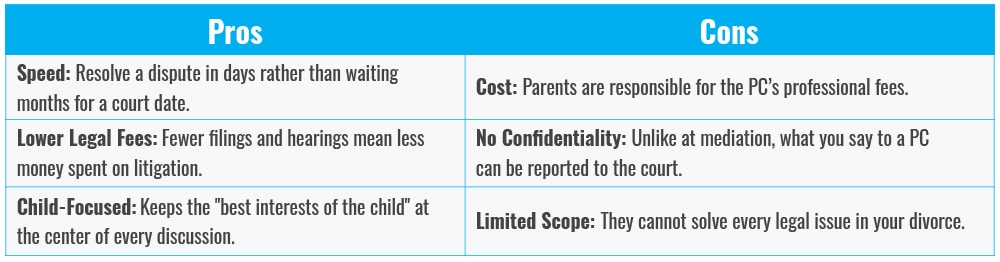
The Pros and Cons at a Glance
Strategic Tips: How to Communicate with Your PC
To get the best results from the process, you must treat your interactions with a PC professionally. Keep these five rules in mind:
1. Be Brief and Factual: Treat your emails like business memos. Stick to the who, what, where, and when.
2. Focus on the Child: Instead of saying “He is being difficult,” try “The current exchange time is making our daughter anxious for school.”
3. Reference the Order: Point to specific sections of the existing parenting time and custody order and/or the Parenting Time Guidelines to support your position
4. Avoid Legal Arguments: Leave the “lawyering” to your attorney. The PC is there to manage the process, not argue the law
5. Remember the Paper Trail: Everything you send to a PC can be reviewed by the Judge. Always stay calm and respectful.
Conclusion
A Parenting Coordinator is an investment in your family’s peace. When used correctly, they reduce the need for aggressive litigation and help parents shift their focus back to what matters most: their children.
At Brown Carrington, our attorneys serve as PCs and help clients navigate this process every day. If you think your case could benefit from a Parenting Coordinator, we are here to help you weigh your options.
Written by: Ryan Cassman
Ryan Cassman is a Partner at Brown Carrington, PLLC, and a Certified Family Law Specialist, Mediator, and Parenting Coordinator with over 20 years of experience. Recognized as an Indiana Super Lawyer every year since 2009, Ryan is known for his balanced approach combining skillful negotiation with strong courtroom advocacy. He’s dedicated to helping families navigate complex legal issues with clarity, compassion, and practical solutions.
Learn more about Ryan here.

Edited by: Catherine Pierce
Request A Consultation
Submitting your information does not create an attorney-client relationship.
DISCLAIMER
THE INFORMATION PROVIDED IN THIS POST IS FOR GENERAL INFORMATIONAL PURPOSES ONLY AND DOES NOT CONSTITUTE LEGAL ADVICE. LAWS AND REGULATIONS VARY BY STATE, COUNTY, AND SPECIFIC CIRCUMSTANCES OF YOUR MATTER, AND THE INFORMATION PRESENTED HERE MAY NOT APPLY TO YOUR PARTICULAR SITUATION. ALWAYS CONSULT WITH A QUALIFIED FAMILY LAW ATTORNEY TO OBTAIN ADVICE TAILORED TO YOUR INDIVIDUAL CIRCUMSTANCES. REVIEWING THIS BLOG POST DOES NOT CREATE AN ATTORNEY-CLIENT RELATIONSHIP BETWEEN YOU AND THE AUTHOR, PUBLISHER, BARROW BROWN CARRINGTON, PLLC OR ITS ATTORNEYS. THE AUTHOR AND PUBLISHER ARE NOT RESPONSIBLE FOR ANY ACTIONS TAKEN BASED ON THE INFORMATION PROVIDED IN THIS BLOG POST.
IF YOU HAVE LEGAL QUESTIONS PLEASE CONTACT OUR OFFICES DIRECTLY FOR A CONSULTATION IN COLORADO, FLORIDA, INDIANA, KENTUCKY, OR OHIO.