

Undocumented Children in Kentucky Family Court
How Kentucky family courts protect undocumented children and when court involvement may open the door to Special Immigrant Juvenile Status
What Is Special Immigrant Juvenile Status (SIJS)?
Why Family Court Plays a Central Role
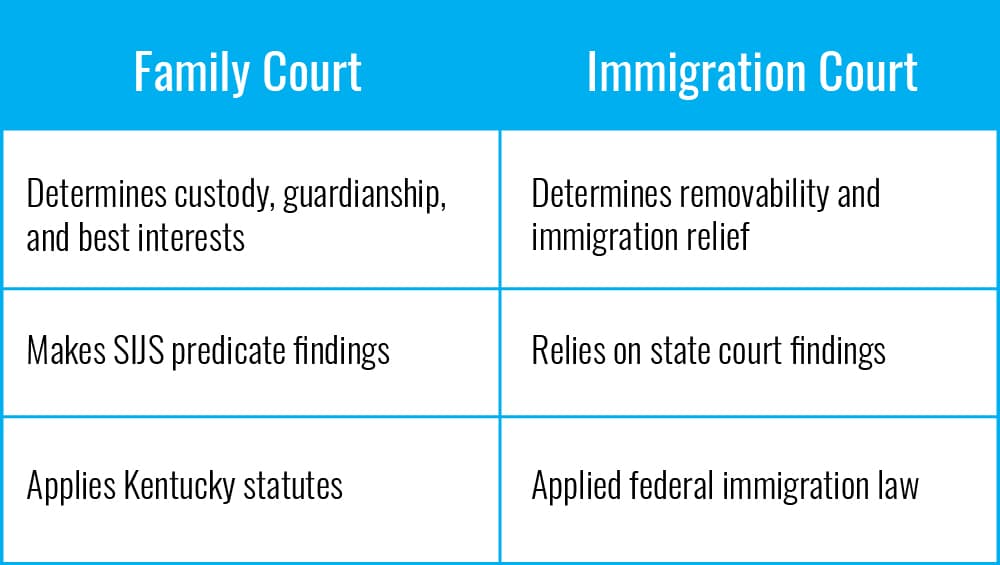
Congress deliberately placed responsibility for SIJS findings in state courts because family courts have expertise in:
• Child custody;
• Dependency, neglect, and abuse proceedings;
• Guardianship of minors; and
• Best-interest determinations.
Immigration courts do not make findings about parental fitness, abuse, neglect, or a child’s best interests. Rather, they rely entirely on the factual determinations made by family courts.
Common qualifying Kentucky proceedings include:
• Custody actions
• Guardianship cases
• Dependency, neglect, or abuse cases
A child does not need to be involved with the Cabinet for Health and Family Services to qualify. Custody or guardianship jurisdiction alone is sufficient, so long as the court is making determinations concerning the care and custody of a minor.
The resulting family court order is commonly called an “SIJS predicate order.”
Why Family Court Plays a Central Role
Step 1: Family Court Jurisdiction Is Established
The child must be before a court exercising juvenile jurisdiction under state law.
Step 2: Family Court Makes Required Findings
The court enters factual findings addressing non-reunification and best interests.
Step 3: SIJS Petition Is Filed with USCIS
Immigration counsel submits the predicate order with the SIJS petition.
Step 4: Adjustment of Status (Green Card)
If approved, the child may apply for lawful permanent residence when a visa becomes available.
Without Step 2, the remaining steps cannot occur.
Required Findings in a SIJS Predicate Order
A legally sufficient predicate order must contain specific factual findings, not merely conclusions, addressing all three statutory elements:
1. Juvenile Court Jurisdiction
The order must state the child’s age and that the court is exercising jurisdiction over the child under state law.
In Kentucky, juvenile jurisdiction generally extends until a child turns 18, or until graduation from high school, whichever occurs later. Timing is critical. A child who ages out loses eligibility permanently.
2. Non-Reunification With One or Both Parents
The court must find that reunification with one or both parents is not viable due to:
• Abuse
• Neglect
• Abandonment
• Or a similar basis under Kentucky law
Only one parent needs to meet this standard. The order should:
• Identify which parent cannot reunify
• Tie the finding to recognized state-law concepts
• Include supporting facts
3. Best Interests of the Child
The court must determine that it is not in the child’s best interests to return to their country of nationality or last habitual residence.
This analysis closely mirrors KRS 403.270 and may consider factors such as:
• Safety concerns
• Lack of caregivers abroad
• Educational disruption
• Medical or psychological needs
• Stability and permanency in the United States
Misconceptions About Undocumented Children in Family Court
-
“Family court can’t help undocumented kids.”
False. Family court is essential. -
“The judge is granting immigration status.”
Incorrect. The court makes factual findings only. -
“Both parents must be unfit.”
Not required. One parent is sufficient. -
“Immigration status controls custody.”
It does not. The child’s best interests control.
Family Court vs. Immigration Court
Frequently Asked Questions
Can undocumented parents get custody?
Yes. Immigration status alone is not determinative.
Does immigration status affect child support?
No. Support obligations apply regardless of status.
Can ICE take my child?
ICE cannot remove a child solely due to a parent’s status.
Do family courts share information with ICE?
No automatic reporting exists.
What happens if a parent is deported?
Family court retains jurisdiction over custody and guardianship.
Can a U.S. citizen child stay in the U.S.?
Yes. Citizenship is not lost due to a parent’s status.
Do I need two lawyers?
Often yes—family law and immigration counsel serve distinct roles.
Do states handle SIJS differently?
Yes. Jurisdictional age limits and procedures vary significantly.
Why Precision Matters
USCIS routinely denies SIJS petitions due to:
• Missing statutory findings
• Conclusory language
• Orders issued without proper jurisdiction
Immigration authorities do not infer findings. They must be expressly stated.
Conclusion
Special Immigrant Juvenile Status is one of the clearest examples of how family courts, including Kentucky, directly shape federal immigration outcomes.
The predicate order is not a formality—it is the legal foundation upon which SIJS rests.
When a family court issues a thorough, well-supported ruling grounded in state law and the child’s best interests, it provides vulnerable juveniles with a lawful path to safety, stability, and permanent residence in the United States.
Did You Know…?
– Immigrant households contribute hundreds of billions of dollars in federal, state, and local taxes and hold a tremendous amount of spending power.
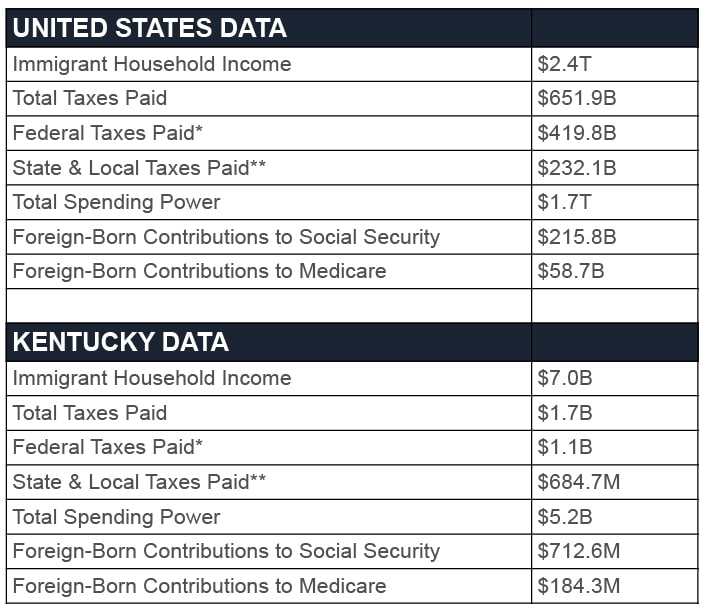
– United States Data
– Kentucky Data
* Congressional Budget Office. 2022. “The Distribution of Household Income and Federal Taxes, 2019.” https://www.cbo.gov/publication/58353.
** Institute on Taxation and Economic Policy (ITEP). 2024. “Who Pays? A Distributional Analysis of the Tax Systems in All 50 States (7th edition).“ https://itep.org/whopays-7th-edition/.
– Undocumented immigrants are INELIGIBLE for federally funded programs like Medicaid, Medicare, or the Children’s Health Insurance Program (CHIP).
• Undocumented immigrants do not receive Social Security benefits (despite paying $26.2 billion into the Social Security Trust Fund in 2023).
• Undocumented immigrants cannot purchase healthcare coverage through the Affordable Care Act Marketplace, and are ineligible for SNAP benefits.
• Undocumented parents can apply for SNAP on behalf of their U.S. citizen children, but benefits can only be calculated based on the number of eligible household members.
• Lawfully present immigrants, including green card holders, can receive some public benefits, but must wait five years before they can apply, with limited exceptions.
• Many immigrants avoid applying for benefits they may otherwise be eligible for due to confusion and fear stemming from the “public charge” rule, leading to mixed-status households unenrolling from public benefits for which they are entitled.
– Higher immigrant population shares are NOT associated with higher crime rates, which aligns with a wealth of prior research on this topic. Using Uniform Crime Reporting data from the Federal Bureau of Investigation (FBI) and population data from the U. S. Census Bureau, the American Immigration Council explored the relationship between total crime rates and immigrant shares of the population between 2017 and 2022 at the state level. Using beta regression analyses and data from all 50 states, the result shows no statistically significant correlation between the immigrant share of the population and the total crime rate in any state.
– For more information on these and other immigration-related topics, please consult the following reputable sources:
• American Immigration Lawyers Association
• American Immigration Council
• Center for Gender and Refugee Studies
If you represent or are caring for an undocumented minor involved in family court, early legal guidance is critical. Timing, jurisdiction, and precise drafting can determine whether relief is possible—or lost forever.
Request a confidential family law consultation to discuss SIJS and family court options.
This article is for informational purposes only and does not constitute legal advice. Attorneys handling SIJS matters should consult current federal regulations and coordinate with experienced immigration counsel.
Written by: Lana Schroeder
Lana K. Schroeder is an associate attorney at Brown Carrington who focuses her practice on all areas of family law, including divorce, custody, child support, and domestic violence matters. With a background in immigration law, Lana brings a deep sense of empathy and understanding to her work, especially in cases involving complex family dynamics or high emotional stakes. Known for her thoughtful and client-centered approach, Lana takes the time to truly listen, explain, and guide her clients toward practical solutions that bring lasting peace of mind.
Learn more about Lana here.

Request A Consultation
Submitting your information does not create an attorney-client relationship.
DISCLAIMER
THE INFORMATION PROVIDED IN THIS POST IS FOR GENERAL INFORMATIONAL PURPOSES ONLY AND DOES NOT CONSTITUTE LEGAL ADVICE. LAWS AND REGULATIONS VARY BY STATE, COUNTY, AND SPECIFIC CIRCUMSTANCES OF YOUR MATTER, AND THE INFORMATION PRESENTED HERE MAY NOT APPLY TO YOUR PARTICULAR SITUATION. ALWAYS CONSULT WITH A QUALIFIED FAMILY LAW ATTORNEY TO OBTAIN ADVICE TAILORED TO YOUR INDIVIDUAL CIRCUMSTANCES. REVIEWING THIS BLOG POST DOES NOT CREATE AN ATTORNEY-CLIENT RELATIONSHIP BETWEEN YOU AND THE AUTHOR, PUBLISHER, BARROW BROWN CARRINGTON, PLLC OR ITS ATTORNEYS. THE AUTHOR AND PUBLISHER ARE NOT RESPONSIBLE FOR ANY ACTIONS TAKEN BASED ON THE INFORMATION PROVIDED IN THIS BLOG POST.
IF YOU HAVE LEGAL QUESTIONS PLEASE CONTACT OUR OFFICES DIRECTLY FOR A CONSULTATION IN COLORADO, FLORIDA, INDIANA, KENTUCKY, OR OHIO.